

SENTIENT Platform
A complete SCADA,and an IIoT platform around it
SENTIENT does everything you would ask of a traditional SCADA — and because it is built as an industrial IoT platform, it carries on past the boundary of one plant: any device, any site, one place to see all of it.
Everything you expect from a SCADA
Before anything else: SENTIENT is a full SCADA system. If you are replacing or extending one, the list below is the part that has to be there, and all of it is included as standard.
- Mimic diagrams with live values and animated states
- Real-time and historical trending
- Alarm and event management with acknowledgement
- Built-in historian with configurable retention
- Setpoint writes, interlocks and loop control
- Recipe management with version history
- Shift, batch and production reports
- Role-based access for operators, engineers and management
- Full audit trail of every operator action
- Redundancy and automatic failover
- Native drivers for the major PLC families
- Scripting and sequence control
The parts you will use every shift
Five of those deserve more than a line, because they are what an operator and an engineer sit in front of all day.
Dashboards & Visualization
Process mnemonics, trends, gauges and tables built against live tags, on screens that work the same way on a control room panel and on a phone out in the plant.
- Drag-and-drop editor for quick screen building
- Mimic diagrams with live values and animated states
- Per-role views tailored to operators, engineers and management
- Responsive layouts for desk, panel PC and mobile

Alarms & Events
Alarm logic that carries context — which asset, which shift, what preceded it — with acknowledgement and escalation recorded against every event.
- Severity, acknowledgement and clearing tracked per alarm
- Escalation by email, SMS or webhook
- Shelving and standing-alarm control to keep the list meaningful
- Full event history for the audit trail

Trends & Historian
Long-term storage sized for process data, so a year-on-year comparison is only a few clicks away and the data behind a report is the same data behind the trend.
- Configurable retention and roll-up per tag
- Multi-tag overlays with cursor readout
- Export to CSV or straight into your BI tool
- Backfill from existing SCADA or CSV archives

Schedules & Reports
Recurring jobs the platform runs on its own — a report at the end of every shift, a setpoint change at a fixed hour, a daily export to ERP — so the routine parts of a day stop depending on somebody remembering them.
- Schedules by shift, calendar, cron or plant event
- Reports generated and delivered without anyone logging in
- Scheduled setpoint, recipe and mode changes
- A run history showing what fired, when, and what it produced

Rule Engine & Automation
Conditions, thresholds and sequences that run on the platform itself, with the same rules available on the gateway so control continues while the link is down.
- Visual rule chains, versioned and testable
- Edge execution so control survives a lost connection
- Scheduled actions, recipes and setpoint changes
- Hooks into ERP, CMMS and messaging

SENTIENT Platform
Where an IIoT platform takes you further
A traditional SCADA is designed around one plant and the controllers inside it, and it does that job well. SENTIENT keeps all of that and adds the things a platform can do once it is no longer tied to a single site.
| A local SCADA | SENTIENT | |
|---|---|---|
| Scope | One plant, one server room | Any number of plants, rolled up into one view |
| Devices | PLCs on the plant network | PLCs, meters, analysers, sensors and third-party gateways, wherever they sit |
| Connectivity | Wired, inside the perimeter | Wired, cellular, LoRa or satellite — remote pump houses and substations included |
| Growth | Sized and licensed up front | Add devices as you go; profiles apply settings automatically |
| Access | Operator stations on site | Browser or phone, with the same role permissions everywhere |
| Data | Serves the control room | Serves the control room, ERP, CMMS and your BI tools alike |
Every site in one place
Plants, substations and remote assets on one map, each keeping its own local control and its own operators.
Any device, from PLCs outwards
Energy meters, flow analysers, weighbridges, gas detectors and vibration sensors sit alongside your controllers.
Reach past the plant network
Cellular and LoRa gateways bring in pump houses, tank farms and pipeline points that never had a screen before.
Open by design
REST, MQTT and webhooks in both directions, so the data belongs to your business rather than to a control system.
SENTIENT Gateway connects to any PLC
The gateway is what makes the rest of it possible. It sits in the panel, speaks whatever the equipment on that line speaks, and presents it to the platform in one consistent form — so a forty-year-old drive and a new controller arrive looking the same.
Any controller
Siemens, Allen-Bradley, Delta, Schneider, Mitsubishi, Omron and the rest, through native drivers or open protocols.
Protocol conversion
Serial, fieldbus and Ethernet on one side; MQTT and secure transport on the other.
Store and forward
Data is buffered locally while the link is unavailable and backfilled in order once it returns.
Rules at the edge
The same rule chains run on the gateway, so interlocks and sequences keep working independently.
Secure by default
Outbound-only connections, per-device credentials and encrypted transport, with no inbound ports opened on the plant network.
Managed remotely
Configuration and firmware are pushed from the platform, so a change does not need a site visit.
Works with the equipment you already have


- Modbus TCP


- CANopen


- OPC DA

- REST / Webhooks

- IEC 61850
- IEC 60870-5-104
- DNP3


- Radio link

- Bluetooth LE

Devices and assets, managed like an estate
This is the part a plant-bound SCADA has no real answer for. Once you are counting devices in hundreds and across sites, they need to be organised the way your business thinks about them — by plant, line and asset — rather than as a flat tag list.
Asset hierarchy
Group by company, plant, area, line and machine, so a reading always carries the context of where it came from.
Device profiles
Define a device type once — its tags, alarm limits and rules — and every device of that type inherits it.
Bulk provisioning
Commission fifty identical meters in one action, with credentials issued automatically.
Firmware and config
Push settings and firmware over the air, staged by group, with a record of what went where.
Credentials and access
Per-device credentials, per-customer tenancies and permissions that follow the hierarchy.
Health at a glance
Connectivity state, last-seen time and battery or signal strength for every device on one screen.
Your plant, in your pocket
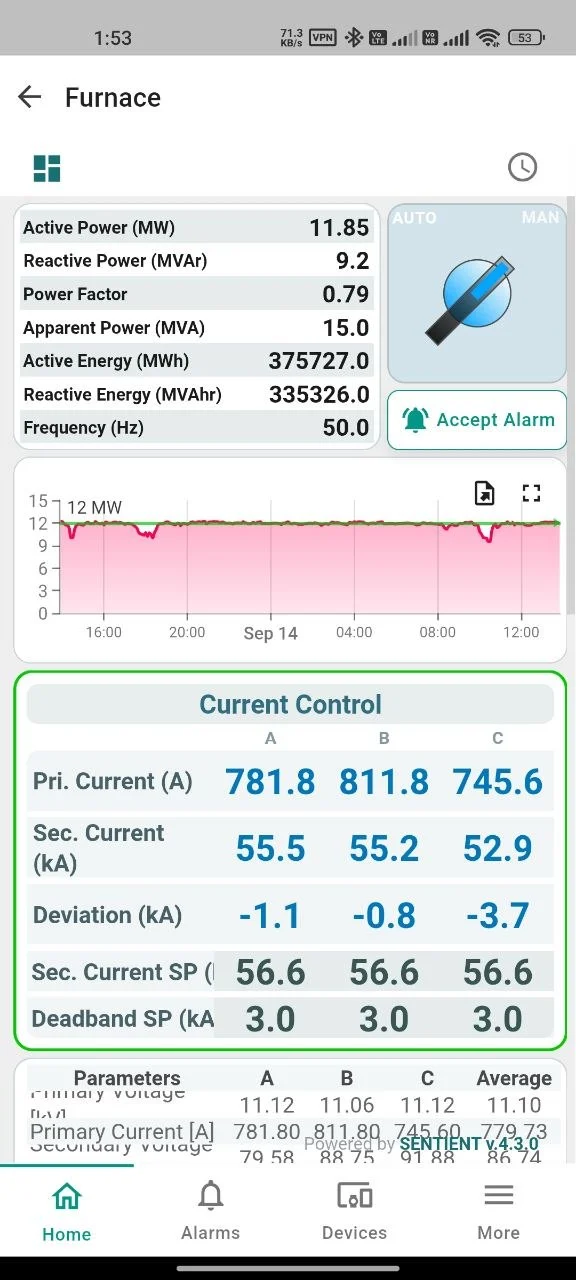
SENTIENT has a native mobile app for Android and iOS, so the plant can be watched from wherever you happen to be — at home, between sites, or walking the floor with the machine in front of you.
Live dashboards
The same screens as the control room, laid out for a phone rather than squeezed onto one.
Alarms as they happen
Push notifications the moment a limit is crossed, with acknowledgement from the phone itself.
Trends on the move
Pull up any tag's history to check whether what you are seeing is new or has been building for hours.
Secure access
The same roles and permissions as the browser, with device-level authentication and remote revocation.
Works on site
Designed for patchy plant Wi-Fi and cellular, with the last known values kept on the device.
Android and iOS
One account across phone, tablet and desk — no separate licence per device.
Alerts reach people where they already are
An alarm is only useful if the right person sees it. SENTIENT delivers to the channel each person reads, and escalates to the next one if nobody acknowledges.
SMS
For the shift in-charge whose phone has no data connection.
Group or individual, with the alarm detail and a link straight to the screen.
Telegram
Channels per line or per plant, useful for maintenance teams.
With the trend attached, for the people who want the context.
Mobile push
Straight to the SENTIENT app, acknowledged in one tap.
Webhooks & more
Into your own ticketing, CMMS or ERP — anything that accepts an HTTP call.

And the rules around them
- Different channels by severity, so a warning does not wake anyone at 2am
- Rosters and shift schedules, so the alert reaches whoever is on duty
- Escalation after a set time if nobody acknowledges
- Grouping and rate limits, so one fault does not send forty messages
Scripting for the things no menu anticipates
Most logic is built visually in the rule engine. When a calculation or a sequence goes past what a rule chain should express, SENTIENT gives you a proper scripting layer to reach for.

Rhai
A small, fast, sandboxed language built into the platform. Scripts run close to the data with predictable performance, which is what you want for a calculation evaluated on every incoming value. Typed, easy to read, and approachable for a process engineer.

JavaScript
The full language when you need it — for complex transformations, integrations with outside services, or logic ported from a system you are replacing. Familiar to any developer you already have.
What people build with it
- Derived tags — specific energy, yield, moisture-corrected tonnage
- Custom alarm conditions that depend on several signals at once
- Payload transformation for an unusual device or protocol
- Report fields that need a calculation the template editor does not cover
- Integrations that post to an internal API on an event
- Batch and sequence logic that spans more than one machine
Reporting, taken seriously
Most of what a plant is asked for at the end of a shift is a number in a report. SENTIENT builds those from the same historian the trends come from, so the figure in the report and the figure on the screen always agree.
- 01
Build it once
A template editor with your own layout, logo and calculated fields — production per shift, yield, specific energy, downtime by reason.
- 02
Run it on schedule
Per shift, per batch, daily, monthly, or triggered by an event such as a batch completing.
- 03
Deliver it where it is read
Email, shared drive, FTP or straight into ERP — in whichever format the person receiving it works in.
- 04
Keep the record
Every generated report is stored and versioned, with the data it was built from still queryable behind it.
In the format each recipient works in
A plant manager wants a PDF to sign off, an accountant wants a workbook to pivot, and the ERP wants a plain file to swallow. The same report definition produces all of them, so nobody is re-keying figures out of a printout.
- PDFLaid out, paginated and signed off
- XLSXExcel workbook with formulas intact
- XLSFor older systems that need it
- CSVStraight into ERP, BI or a script
- ODSOpenDocument, for LibreOffice
Reports out of the box
Production
Output per shift, line and grade, with rate and yield against target.
Downtime
Stoppages by duration, line and reason code, ranked so the worst offender is obvious.
Energy
Consumption per unit produced, by feeder and by machine, with peak demand tracking.
Alarms
Frequency, duration and repeat offenders, for rationalisation reviews.
Batch
A full record per batch — recipe used, parameters achieved, deviations flagged.
Asset
Runtime hours, starts and service intervals, per machine and per site.
Analytics on top of your reports
Once the reports exist, the useful questions are the ones that span them. SENTIENT keeps the underlying data available, so the same figures can be compared across shifts, lines and sites without exporting anything.
Compare anything
Shift against shift, line against line, this month against last — on the same axes, from the same source.
KPIs that update themselves
OEE, availability, specific energy and yield calculated continuously rather than assembled by hand.
Anomaly detection
Patterns learned from your own operating history, so an alert reflects how your plant behaves.
Drill down to the tag
Start from a number in a monthly report and work back to the minute and the tag that produced it.
Built on the Industry 4.0 principles
Industry 4.0 is usually described by four design principles. They are a useful way to read everything above, because SENTIENT is the data and connectivity layer a programme like that rests on — the part that has to be in place before any of the rest becomes possible.
Interconnection
Machines, devices, sensors and people able to reach one another. The gateway speaks to any PLC across 25 protocols, brings in meters, analysers and sensors alongside them, and reaches remote sites over cellular or LoRa.
Information transparency
Production data collected and given context. The asset hierarchy means a reading always carries the plant, line and machine it came from, and the historian keeps it long enough for the comparison to be worth making.
Technical assistance
Information shaped to help people decide and act. Role-based dashboards, alarms that escalate until someone acknowledges, reports delivered in the format each recipient works in, and the plant in your pocket when you are not on site.
Decentralised decisions
Routine decisions made where they happen. Rule chains run on the gateway as well as the server, so interlocks, sequences and setpoint changes carry on independently — and keep logging — while the link to the server is down.
Of the wider Industry 4.0 picture, SENTIENT covers the connectivity, data, analytics and systems-integration side. Robotics, additive manufacturing and augmented reality sit alongside it rather than inside it — and every one of them needs a data layer like this underneath to be worth installing.
How we support you
The platform is ours, so the people configuring it are the people who built it — and the same team wires the panel it talks to.
Cloud & On-Premise Deployment
On your own server, in your own DMZ, or hosted by us — including air-gapped sites where nothing may leave the plant network.
PLC & Device Integration
Modbus, OPC UA, MQTT, Profinet and vendor protocols, plus the gateway hardware and the panel work to bring signals out of existing equipment.
Custom Dashboard Development
Screens drawn from your P&ID and shift reports, so they match the way your plant is run.
Reports & Analytics
Report templates and KPI definitions built with your team, so the numbers match the ones your business already uses.
Predictive Maintenance
Vibration, temperature and load trending against thresholds tuned to your own operating history.
Support & AMC
Annual maintenance with a named engineer, remote diagnostics and a response time agreed in writing.
Deployed to suit your site
The same build runs on a single gateway in a substation and across a cluster serving several plants, so sizing is simply a matter of configuration.
- 01
Edge
A gateway in the panel, collecting and controlling locally. Keeps running and keeps logging with the uplink down.
- 02
On-premise
A server inside your own network, so nothing leaves the site — which is what most plants, and every audited one, prefer.
- 03
Cloud
Hosted by us or in your own tenancy, for multi-site rollups and access from outside the plant.
- 04
Hybrid
Edge control with cloud reporting, which tends to be the right fit once more than one site is involved.
Security is mostly a question of where it runs
What keeps an industrial system safe is decided by where the data sits and who can reach it, long before any feature list. These are the decisions SENTIENT was built around.
Nothing has to leave the site
Edge and on-premise deployments keep every tag, trend and report inside your own network. Cloud is an option, not a dependency — the same build runs either way.
No open door into the plant
Remote access goes over your VPN rather than a port exposed to the internet. The platform never needs the plant network to be reachable from outside it.
Read-only where it should be
Off-site dashboards can be read-only, so a phone showing production figures is not also a way to move a setpoint.
Roles, not a shared password
An operator, an engineer and a manager see and change different things. Access is granted per role rather than by handing one login around the shift.
A record of who changed what
Configuration and setpoint changes are attributed and timestamped. That is what lets an incident be reconstructed afterwards instead of argued about.
A network failure is not a plant failure
The gateway keeps collecting, logging and controlling with the uplink down, so losing connectivity costs you visibility, not data or control.
These are design decisions, not an assurance. SENTIENT has not yet been through an independent security audit or been certified against a standard such as IEC 62443, and this page will say so plainly until it has. If your procurement needs evidence before then, tell us what it has to cover and we will work through it with you.
Industries we work in

Licensing
SENTIENT is licensed by tag count, so you pay in proportion to what you connect. Tell us roughly how many points you expect to bring in and we will size it for you — the historian, rule engine, recipes, reports and analytics are included at every tier.
Bring SENTIENT to your plant
Send us a tag list, a screenshot of your current system, or simply a description of what you would like to see on screen. One of our engineers will come back to you with a clear proposal.